
Short version: don’t chase and don’t call. Put something that smells like home outside your door, file a lost report where a finder will actually see it, and then call the number for your city — which is a different number in almost every city in this metro. Do the reporting before you start driving around. In most lost-dog cases you’re not looking for a dog, you’re looking for the person who already has him.
That last part sounds wrong the first time you hear it. It’s most of what’s below.
The first hour, in order
Stop moving toward the dog. If you can still see him, this is the single most important thing on this page. The Missing Animal Response Network, which has been studying lost-pet behavior since the late nineties, puts it bluntly: a dog that’s lost is often in flight mode, and calling him can be the trigger that sets him running. Chasing makes it worse, and chasing includes walking toward him and following in a car. Instead, sit down or lie flat, look away, talk quietly, and let him come close and touch you first. It’s the exact opposite of what your body wants to do, and it’s what the people who do this for a living tell you to do anyway.
Put out something that smells like you and like him. Strong wet food, his bed, the laundry basket — right outside the door he left from. MAR’s advice is to build a reason for him to come back to a place he already knows rather than to go find him. If someone can stay at the house while others make calls, do that.
File the lost report before you start searching. This is the step people put off, and it’s the one that turns a stranger’s “somebody’s dog is in my yard” into a phone call. Petco Love Lost is free, matches lost and found photos across a national database, and is the service Minneapolis Animal Care & Control partners with — it’s also the first step the Animal Humane Society lists. Both of them then point people at the same two Facebook pages, Lost Dogs MN and Lost Cats MN, and at Nextdoor. Post a clear, recent photo. Keep the details thin — a phone number and a general area is enough, and MAR warns that a very specific location brings well-meaning strangers into the search area who can move your dog somewhere you aren’t looking.
Then call your city. Which is where this gets local.
Who takes the report depends on which city you’re in
There’s no single number for the metro. The Animal Humane Society publishes a list of Minnesota cities and the impound facility each one uses, and it currently runs to 199 cities pointing at 63 different facilities. The note at the top of that list is the shortest true answer to “who do I report this to”: contact the police.
Minneapolis runs its own shelter. Minneapolis Animal Care & Control is at 612-673-6222, and the city routes animal calls through 311 — 311 inside the city, or 612-673-3000. Its lost-pet page is worth reading in full, because it lists three separate places to look: the animals at the city shelter, a 30-day list of strays that residents found and are keeping at their own homes, and a dashboard of dead animals the city has picked up in the last 30 days. That last one is a hard link to click. It’s also there for a reason, and better found on your own terms than not at all.
Saint Paul runs its own shelter too. Saint Paul Animal Services says that if you’re looking for your lost pet, call 651-266-1100 during operating hours — phones are staffed weekdays 8:30 a.m. to 5 p.m., and the shelter is open to the public weekdays 12:30 to 4:30 p.m. After hours the city directs people to the Saint Paul Police non-emergency line at 651-291-1111, and says to call 911 if an animal is sick, injured or in danger.
The suburbs contract it out, and not all to the same place. Two of the big ones:
- Companion Animal Care & Control impounds for more than 70 municipalities across Anoka, Chisago, Ramsey and Washington counties, plus two counties in Wisconsin, at a single facility in Oakdale. Some of those cities pay it to pick animals up; others only pay for the kennel, and in those the police do the pickup. Its own service-area page says which is which, and says that in impound-only cities it won’t accept an animal handed over by a member of the public without a case number from local law enforcement.
- PUPS — Pets Under Police Security — is a shared kennel in Maple Grove serving Plymouth, Brooklyn Center, Brooklyn Park, New Hope, Robbinsdale and Maple Grove itself. Plymouth’s animal control page gives the number as 763-494-5999, and both cities say the way to see whether your pet is there is to search the PUPS Facebook page.
And then there are the cities that don’t use a shelter at all. On that same list, Anoka sends animals to its own containment center at the police department, and a good number of suburbs send them to a veterinary clinic or a boarding kennel. If your dog is impounded in one of those, he isn’t on any adoption website, because the place holding him doesn’t run one.
One thing about every number on this page, ours included: check your city’s own page before you dial. Cities change contractors, facilities move, and numbers get renumbered, and none of that reaches an article written in September. We checked each of these against the source it came from, and the source is still the one that’s right today. Treat what’s here as a map of how the system works, not as a phone book.
Finding your own city’s answer in two minutes
- Search your city’s name plus “animal control.” Nearly every city site has a page, and it names the facility the city uses and the number to call.
- Open the impound facility list. City, facility, which species that facility takes, and two phone numbers. It’s the closest thing to a metro-wide directory that exists.
- Call your police department’s non-emergency line. Dispatch knows who picks up animals in your city, because they’re the ones who send them.
Any of the three beats a number you found somewhere else, this page included.
The impound is a place you go, not a website you check
If your dog does get picked up, Minnesota sets a floor on how long he’s held. Minn. Stat. § 346.47 requires animals seized by public authority to be held for redemption by the owner for at least five regular business days, or longer where a city ordinance says so. “Regular business day” has a definition, and it matters: a day the facility is open to the public for at least four consecutive hours between 8 a.m. and 7 p.m.
Look at what that means in practice. PUPS is open Mondays and Fridays from 10 to noon and 2 to 6, Tuesday through Thursday from 2 to 6, and closed Saturdays and Sundays. So the clock moves slowly — and so does your chance to walk in and look.
Which brings up the part of the same statute nobody mentions. Facilities holding seized animals have to keep records — species, breed, sex, approximate age, distinguishing traits, where the animal was picked up, what date — in a form the public can read, and anyone may view those records and the animals themselves during open hours. That’s a legal right to walk in and look with your own eyes, and it exists because descriptions over the phone go wrong constantly. A wet, matted, frightened dog with no collar does not look much like the photo on your fridge, and a staff member who has never met him is matching your words against a kennel card.
The facilities say this themselves. Companion Animal Care & Control’s lost pets page notes that it serves a large number of cities and does its best to review lost reports, but that owners are responsible for monitoring its listings to find their own animal. Read that as an instruction rather than a disclaimer.
Minnesota does put a duty on the other side too: Minn. Stat. § 346.54 requires shelter staff who receive an animal to check it for identification, work out who the owner is where they can, and notify that person promptly. That’s exactly why the next section matters.
A microchip is only as good as what’s registered to it
A chip number isn’t a phone number. It points at a registry, and the registry holds the contact details — which means a chip implanted at a clinic five years ago and never registered, or registered to a phone number you’ve since changed, will scan perfectly and lead nowhere.
Check it now, while you’re waiting for callbacks. The free AAHA pet microchip lookup tool takes a chip number and tells you which registries hold a record for it, most recently updated first — it won’t show contact details, but it tells you who to phone. Then call that registry and make sure the number on file is one that rings on the phone in your hand. If you don’t know your dog’s chip number, your veterinary clinic has it in his file.
Two things worth knowing while you’re in there. The lookup can return several possible registries for one chip, especially numbers starting with 900, and the advice is to work down the list. And AAHA has flagged that one registry, Save This Life, has ceased operations and has been disconnected from the lookup — if your dog’s chip number starts with 991 or 900164, the chip itself is fine, but the registration may need to be redone with another company.
Worth knowing on the tag side too: not every city licenses pets any more. Plymouth, for example, dropped dog and cat licenses but still requires both to carry some form of identification — a microchip, or a tag with a phone number or address.
Where dogs actually go
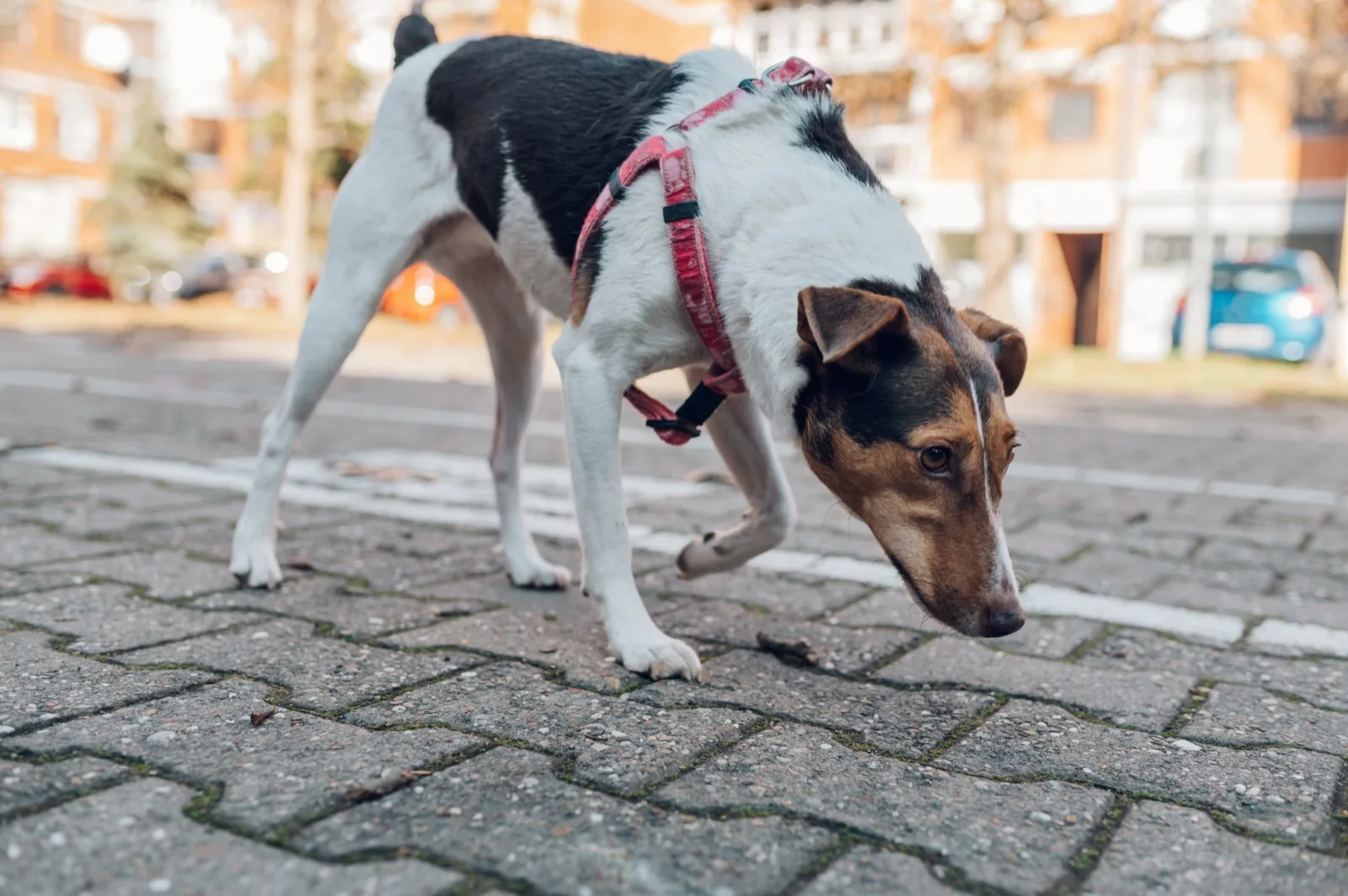
MAR groups the reasons dogs end up out there into three, and they predict different searches. A dog who slipped through an open gate is usually on an opportunistic journey — nose down, doubling back, drifting a few blocks. A dog who bolted at a bang is in blind panic, and those run fast, run far, and avoid people, including the people they live with. Weather compresses all of it: MAR’s observation is that snow, heavy rain and extreme cold shorten the distance a loose dog covers, which means a storm makes your search radius smaller, not larger.
What actually finds them is less romantic than a search party. In a national survey of 1,015 pet-owning households (Weiss, Slater and Lord, Animals, 2012), owners who got their dog back were asked how. Forty-nine percent found the dog by searching their own neighborhood. Twenty percent said the dog came back on its own. Fifteen percent were contacted because of a tag or a microchip. Seven percent had a neighbor bring the dog home, and six percent found the dog by visiting or contacting animal control. The same survey found 93% of the lost dogs and 75% of the lost cats were recovered. That’s a national average from a 2010 phone survey, not a forecast for your dog — the same table records the 7% and the 25% who weren’t.
Read that list again and notice how much of it runs through other people. Which is the argument for spending the first hour on reports, posters and doorbells rather than mileage. Tell every house you can see. Tell the ones you think already know.
A missing cat is a different problem
If it’s your cat who’s out, most of the impound advice above doesn’t apply, and that’s not an oversight in your city — it’s policy.
On that metro-wide impound list, 58 of the 171 cities that name which species their facility takes say dogs only. Minneapolis states plainly that it does not impound healthy stray cats, giving two reasons: outdoor cats aren’t prohibited in the city, and a cat left where it’s found is more likely to make its own way home. Saint Paul appears on that same list as taking dogs, injured or sick cats, and orphaned kittens. So for a lot of the metro there simply is no cat impound to check, and the weight shifts onto the lost report, the neighbors, and searching very close to home.
The survey above found the same split from the other direction: for cats, the most common way a lost pet turned up was by coming back on its own — 59% of successful recoveries, against 30% found by searching the neighborhood. Cats were also far less likely to be wearing anything: 56% of the lost cats in that sample had no tag, no license and no microchip, against 11% of the dogs.
Two practical things follow. Search your own property properly first, including sheds, crawl spaces, under decks and the neighbor’s garage — quietly, at night, when it’s still enough to hear a small sound. And put the report where a person will see it, because for cats there’s often no institution that will.
If the situation is the other way round and you’re the one holding somebody else’s animal, the mirror of this article is what to do when you find a stray dog or cat here — including who to call, and why a loose cat is a different call than a loose dog.
What changes when the weather turns
This is the part of the page that’s written for Minnesota rather than copied from somewhere warmer, and it starts earlier in the fall than people expect.

You lose the evening. Clocks go back on November 1 this year, and the very next day the sun sets in Minneapolis at 4:59 p.m. By the end of November it’s down at 4:33. Your searchable daylight after work goes to nothing overnight, so the practical move is to shift effort into the things that work in the dark — posting, calling, knocking, and leaving food and scent out — and save daylight for walking.
November is loud. Thunder and fireworks are the classic triggers for a dog bolting, and in Minnesota the fall version is gunfire: the statewide firearms deer season opens November 7 this year, and the metro deer management zone runs November 7 to 29. If your dog is noise-sensitive, that’s two weeks to be deliberate about doors and gates.
Cold changes the stakes rather than the method. Fur isn’t the insulation people assume. What veterinarians watch for is frostbite on ears, tails and feet, where blood flow drops first, and the National Weather Service puts exposed skin freezing in about 30 minutes at 0°F with a 15 mph wind — an ordinary January night here. We’ve written more about what cold actually does to a dog. None of that is a reason to give up; it’s a reason to move faster, because an hour in December costs more than an hour in June.
And the holidays stretch the hold. Five regular business days is measured in days the facility is actually open. Drop Thanksgiving or the week between Christmas and New Year into the middle of that and the legal minimum can span two calendar weeks. That’s longer to wait — and it’s also more days than you’d guess in which the door is open for you to walk in and look.
One warning, because it’s local and current
Minneapolis Animal Care & Control has published a warning about scams aimed specifically at people who’ve lost a pet. Callers pose as shelter staff, sometimes spoofing the city’s own phone number and using photos taken from lost-pet posters, and claim the animal needs emergency surgery that has to be paid for right now. The city says plainly that it will never ask for money over the phone or by text to return a pet, and that reclaiming an animal means coming in and showing proof of ownership — photos of you with your pet, adoption paperwork, a bill of sale, or vet records.
If a call like that comes, hang up and dial the organization back on the number from its own website. Somebody three days into looking for their dog will believe almost anything, and the people running this know that.
Start here
Sit down instead of running. Put food and bedding outside the door. File the report on Petco Love Lost and on the local Facebook pages. Then find your city’s number — your city website, the impound facility list, or the police non-emergency line — and go look at the facility in person as soon as it’s open.
If your search takes you into calling around, our directory of Minnesota rescues and shelters lists organizations by city, including Minneapolis and Saint Paul, and you can browse every city we cover from one page.