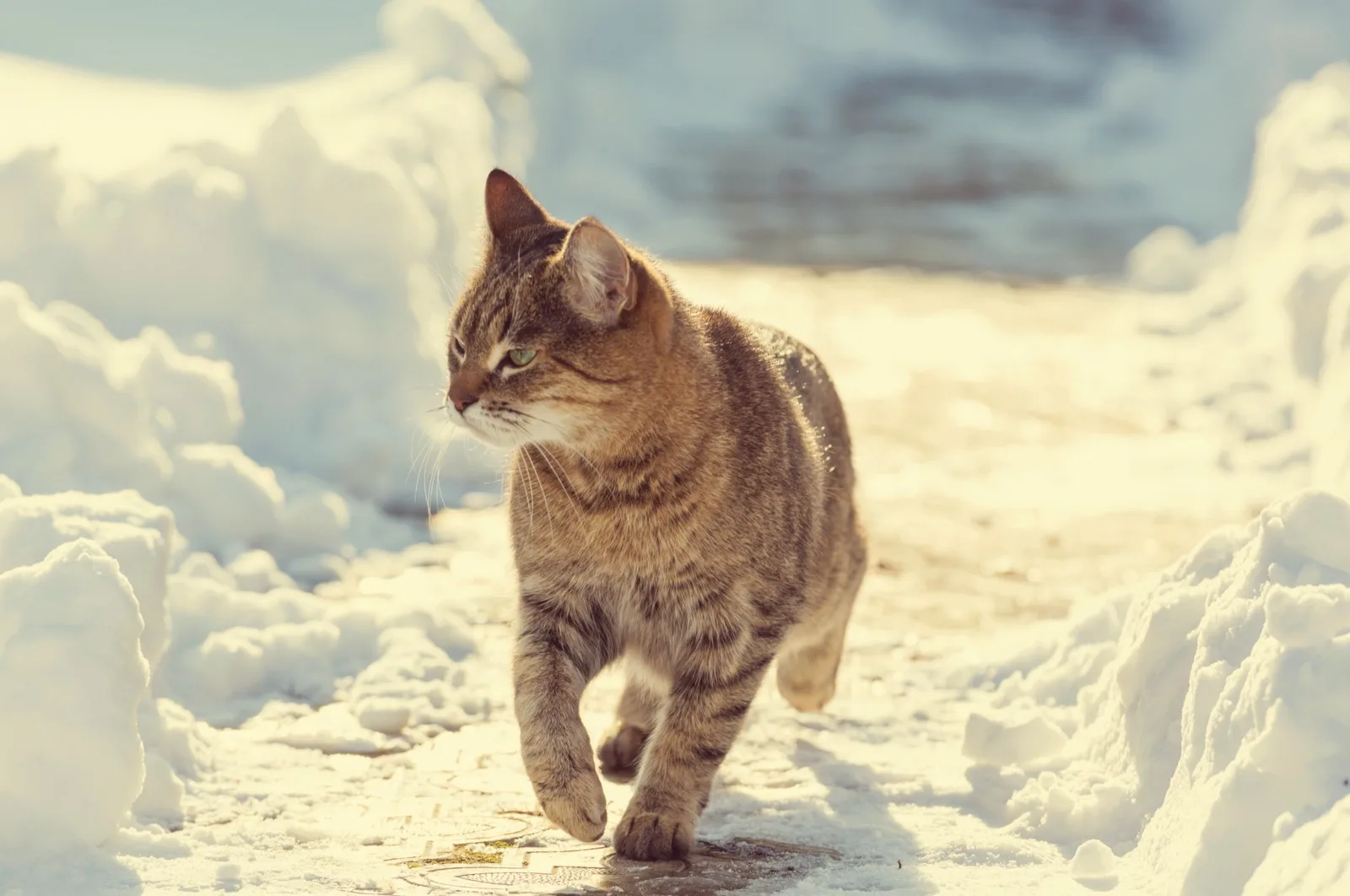
Minnesota gives you about five months to get this right, and the question everybody asks first is the simple one: how cold is actually too cold?
There’s a number, and then there’s everything that moves it. Both are below. And because this is a question people mostly ask while looking out a window at a cat they don’t own, the second half of this is about the cats who live outside — what a winter shelter needs, why straw and hay are not the same thing, and how to keep a water bowl liquid at 8°F.
The short answer
Below about 45°F, most cats start to feel it. Freezing is where it turns medical. Washington State University’s Veterinary Teaching Hospital is direct about the time limit: once the temperature dips below 32°F, most dogs and cats — especially thin-coated ones — shouldn’t be outside more than 10 to 15 minutes without access to somewhere warmer.
A cat’s normal body temperature runs around 100 to 102.5°F. WSU grades hypothermia in three bands:
- Mild — 90 to 99°F
- Moderate — 82 to 90°F
- Severe — below 82°F
Those are body temperatures, not air temperatures, and they’re why “it’s only a few degrees below freezing” isn’t reassuring on its own.
What a Minnesota January actually is
This is the part a guide written for a milder climate can’t do for you.
Minnesota DNR publishes daily climate normals for Minneapolis/St. Paul, and the January page — averages from 1991 to 2020 — is worth sitting with. The normal daily high is 23 to 25°F every single day of the month. The normal overnight low runs 8 to 11°F, bottoming out around 8°F in the third week.
Read that again: in an average January here, the average day never gets above freezing, and the average night is more than twenty degrees below it. The record for January 21 is -41°F, set in 1888.
So the 10-to-15-minute guidance isn’t an edge case in this metro. It’s most of January.
What changes the number
Two cats in the same alley can be having very different winters.
- Coat. A dense-coated cat is carrying equipment a short-haired cat simply doesn’t have. WSU singles out shorthair cats as particularly vulnerable.
- Wet. This is the big one and it’s underrated. A damp cat loses heat fast, and VCA notes that wet or damp paws, ears and tails are more vulnerable to frostbite than dry ones. Wind does the same job.
- Size and age. Kittens and senior cats both regulate temperature poorly. A small cat has more surface area for its mass and less of itself to keep warm.
- Health and weight. VCA points out that cats with heart disease, diabetes or anything else that reduces blood flow to the extremities are at higher frostbite risk.
- Whether there’s anywhere to go. A healthy adult cat with a dry, wind-proof, straw-packed box is in a completely different situation from the same cat with nothing. This is the variable you can actually change, which is most of why this article is long.
Watch the cat, not the thermometer
Shivering is the obvious signal and it isn’t the first. Before that you’ll usually see a cat that’s gone quiet and hunched, tucked tight, slow to get up, or suddenly very interested in a doorway it normally ignores.
Ear tips are where this shows up first. VCA’s frostbite page is specific about it: the ear tips of cats are especially vulnerable, and damage can happen to that tissue very quickly. Paws and tail next. Frostbitten tissue may look pale or grey while it’s still cold, then go red and painful as it thaws — and the signs can take several days to appear, especially on a small area like a tail tip.
If you’re looking at suspected frostbite, two things not to do: don’t rub the area, and don’t use direct heat. VCA’s interim first aid is warm — not hot — water, in the range of 98.6 to 113°F, which is the range you can comfortably hold your own hand in. Pat dry afterward rather than rubbing with a towel. Then call a vet. Hypothermia gets treated before frostbite, and both are clinic situations rather than wait-and-see ones.
If you want the same reckoning for the other animal in the house, we’ve written how cold is too cold for a dog — same structure, different numbers, and the paw-and-salt section applies to cats who walk on treated sidewalks too.
The cat outside your window: which kind is it?
Before you plan anything, spend two minutes working out what you’re looking at. The right action is completely different for each, and getting it wrong is the most common failure in this whole topic.
Look at the ears first. A cat missing the tip of one ear has been through a trap-neuter-return program. It’s a universal marker, it means the cat is already spayed or neutered and vaccinated, and it means the cat lives outdoors as its home. That cat doesn’t need rescuing. It may still appreciate a dry box.
A cat that walks up to you and lets you touch it is socialized to people, which usually means it lived with some. Treat that one as a lost pet: get it scanned for a microchip and file a found report. Our guide to what to do when you’ve found a stray dog or cat walks through who to call in this metro, and why a loose cat is a different phone call from a loose dog.
A cat that won’t let you near it and has been in the neighborhood for months is probably a community cat, with or without an eartip. The useful move there isn’t capture — it’s shelter, food and water, and a call to a TNR group if nobody’s gotten to it yet.
And if the cat is limping, wounded, won’t get up, or has visibly frozen ears, the category stops mattering. That’s a veterinary call.
How community cats actually get through winter
Mostly by being better at this than we assume.
Cats who live outdoors year-round know their territory in a level of detail no caretaker does — which deck is dry underneath, which shed door doesn’t latch, which foundation wall holds heat. Alley Cat Allies’ position is that cats have lived outside as a species for a very long time, are adapted to their environments, and generally know where to find food and shelter. Its cold-weather advice is built around supporting that rather than overriding it.
Which is a relief, because it means the job in front of you is small and concrete: make the dry spot drier, the warm spot warmer, and the water liquid.
If the cats aren’t using the shelter you built, Alley Cat Allies suggests finding where they are sleeping and upgrading that spot instead — adding straw to the place they’ve already chosen. That’s the whole philosophy in one tip.
Shelter: small, dry, elevated, one small door
Every bit of this is counterintuitive, which is why most shelters people build are too big.
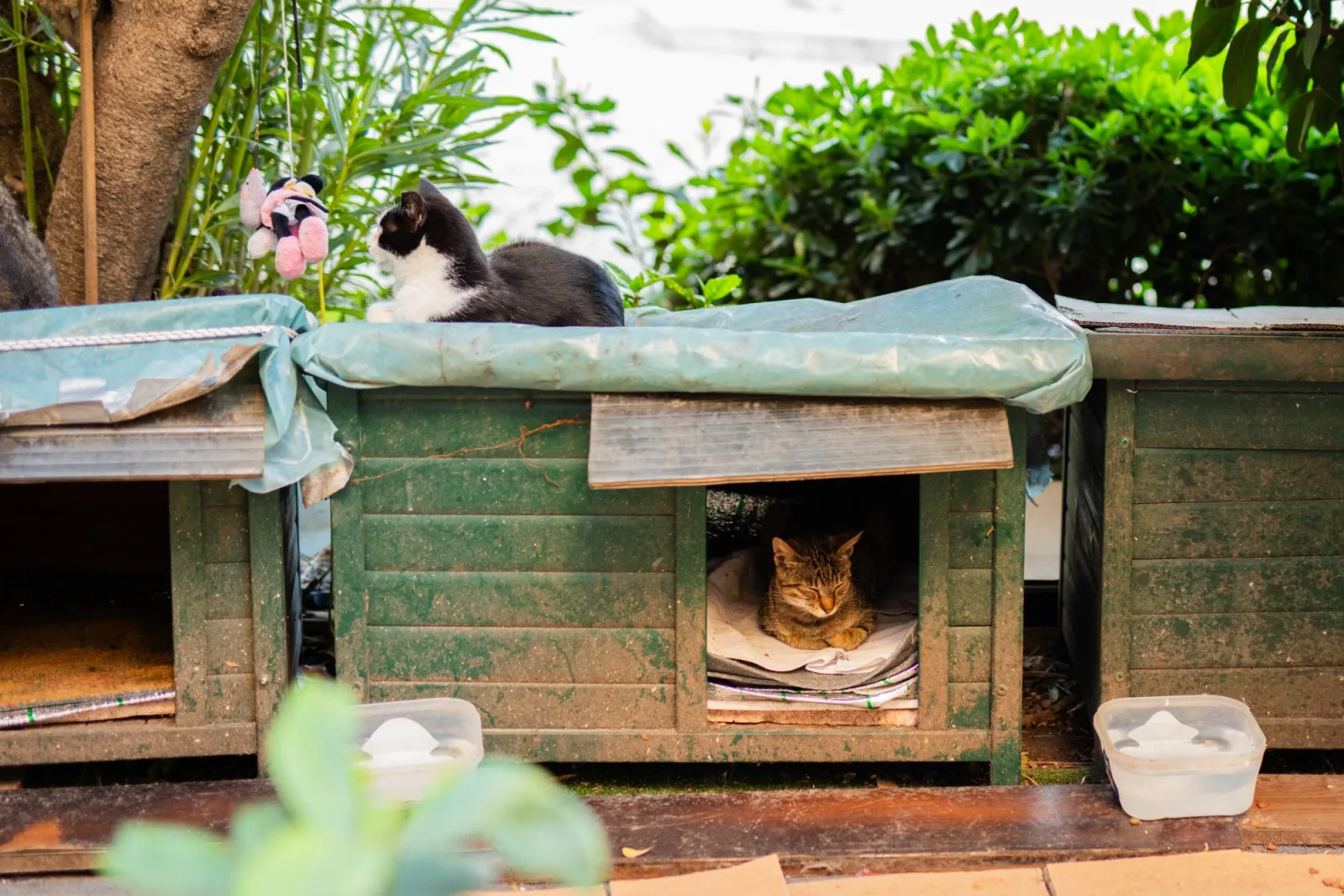
Neighborhood Cats reduces a winter shelter to three requirements: it’s well insulated, it’s waterproof, and it leaves a minimum of open air space when the cats are inside. There’s no furnace in there. The cats are the furnace, and empty volume is what they’re fighting.
So, the specs that matter:
- Small, not spacious. Alley Cat Allies recommends roughly two feet by three feet and at least 18 inches high, sized for three to five cats. If only one or two cats use it, make it smaller — less body heat needed to warm it. Bigger shelters just leave the inside as cold as the outside.
- A doorway only a cat fits through. Six to eight inches wide. That keeps out other animals, and it keeps warm air in.
- The door sill a few inches above the floor. Neighborhood Cats is particular about this on Styrofoam builds, and it’s the detail people skip: it stops rain and meltwater running straight into the bedding.
- Elevated and level. Off the cold, damp ground — wood pallets or bricks. Weigh the top down so it doesn’t move, without crushing the roof.
- Entry facing away from the wind, and ideally toward a wall or fence, so the approach itself is sheltered and only a cat can get in.
- Placed where the cats already are, near the feeding spot, against something familiar rather than out in the open. Out of the wind but in the sun if you can manage both.
Two details where the popular advice is wrong, or at least oversold:
You probably don’t need two doors. The common DIY wisdom is to cut a second exit so a predator can’t trap a cat inside. Neighborhood Cats’ read is that two doors create drafts and give away warmth, that the chance of a predator cornering a cat in a shelter is remote, and that a second door is worth it only where there are frequent predators like coyotes. One door, well placed, is the default.
Add the door flap later. A flap does help hold warm air in, and Neighborhood Cats says well-built shelters do the job without one. If you add one, wait until the cats are already using the shelter — a flap on a brand-new box can be the reason they never go in. Make it waterproof, thick enough to insulate, and light enough for a cat to nose aside.
Straw, not hay. This is the one people get wrong.
If you take one thing from this page, take this one.
They look alike in the bag. In a shelter at 10°F they behave like opposite materials.
| Straw | Hay | |
|---|---|---|
| What it is | The dry leftover stalks from a harvested crop | Animal feed — dried grass, cut green |
| Moisture | Repels it. Stays dry and insulating | Soaks it up. Goes damp, then freezes |
| Mold | Stays clean when kept dry | Can grow mold |
| Look | Tough, thick, lightweight, yellow or golden | Usually heavy and green |
| Price | The cheaper of the two | Typically two or three times more |
That price gap is the fastest way to tell them apart at a store, and Alley Cat Allies says so outright: hay generally costs two or three times what straw does. If you can’t tell from the bag, ask the clerk.
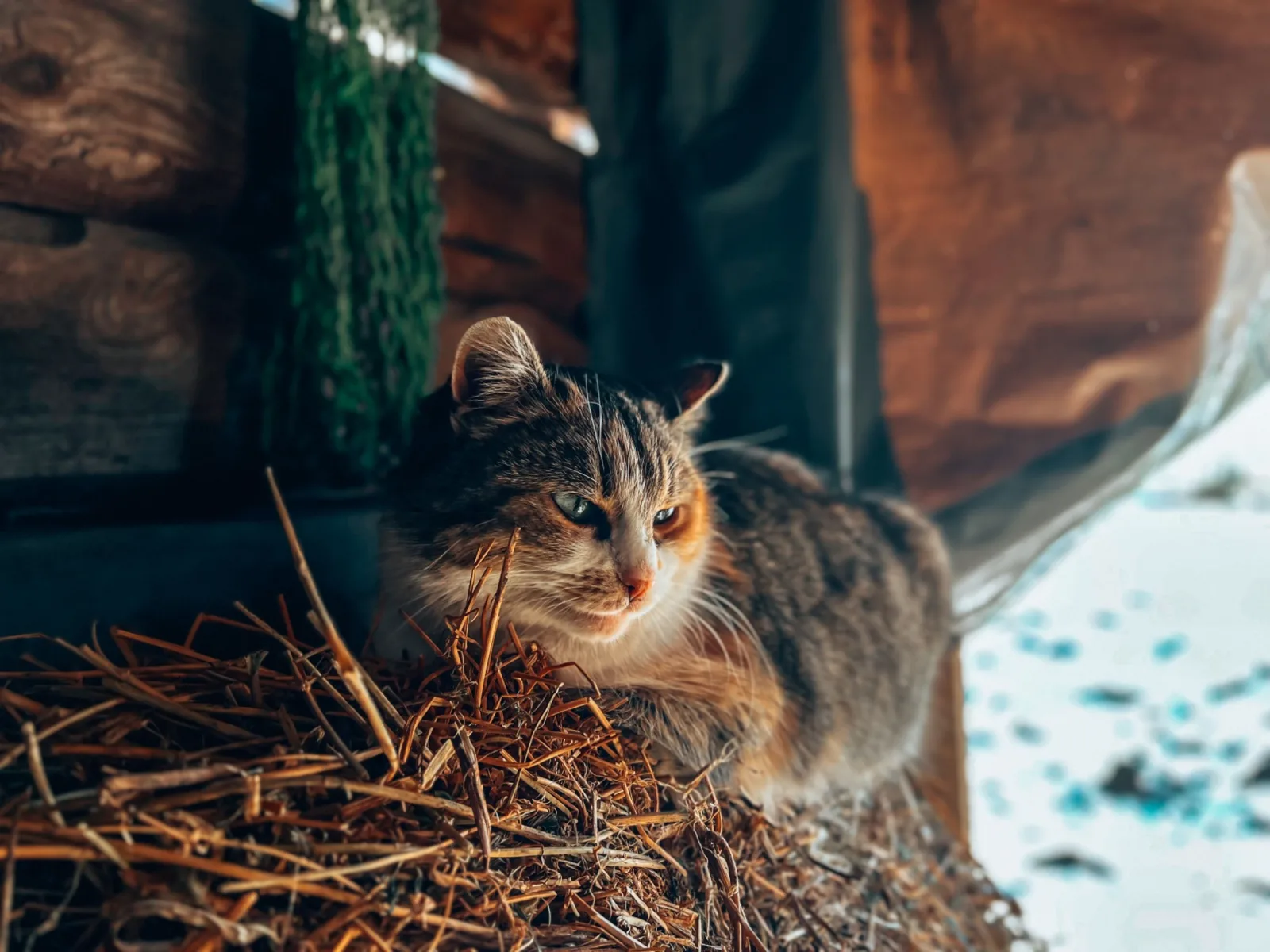
The mechanism is the whole point. Hay is grown to be eaten, so it still holds moisture; a bed of it in a cold shelter gets wet, can go moldy, and a wet bed in winter is actively dangerous. Straw is a hollow, dry stalk with the grain removed, so it sheds moisture and keeps insulating — and cats can burrow down into it, which is what you want. Insulation that surrounds a cat does far more than something a cat lies on top of.
A few practical notes:
- Pack it loosely to the quarter or halfway point of the shelter, not solid to the lid.
- Skip blankets and towels. Both Alley Cat Allies and Neighborhood Cats warn against them: they soak up moisture like a sponge, and a cat lying on top of a flat towel is giving heat away rather than trapping it.
- Mylar goes under the straw, not instead of it. A Mylar emergency blanket lining the walls reflects body heat back, and then you lay straw over it.
- Replace any bedding that gets damp, immediately. Damp straw is hay.
- Refresh it every few months, and before a cold snap if you can.
- Where to buy it: farm and livestock suppliers, garden centers, some pet stores and craft stores, and neighbors with horses. Watch for autumn decorations coming down in early November — those straw bales are often free for the asking. Stored dry and off the ground, straw keeps essentially forever, and one bale is far more than a single shelter needs, so it’s worth splitting with another caretaker.
Two builds that work
Neither needs tools you don’t have.
The nested-tub shelter. Alley Cat Allies’ step-by-step version: take a roughly 30-gallon plastic tub and a roughly 20-gallon one. Hold a plastic flowerpot against the big tub, trace the opening, soften the plastic with a hair dryer so it cuts cleanly, and cut it out with a box cutter. Lay a thin slab of Styrofoam in the bottom of the big tub, set the small tub inside, mark and cut a matching doorway. Pack straw into the gap between the two tubs, fill the inner tub with straw for bedding, cut the bottom out of the flowerpot and slide it through both doorways as a tunnel entrance. Lids on. Done.
The Styrofoam cooler. Neighborhood Cats’ version uses a shipping cooler at least 1.5 inches thick — the kind food and medicine arrive in. Cut a 6-by-6-inch doorway in a short side, keeping the bottom of the opening a few inches above the floor of the box. Silicone the lid on permanently, which is what makes it waterproof. A coat or two of exterior latex deck paint in a color that blends in protects the foam and keeps the neighbors comfortable. Straw inside.
Scaling, from Neighborhood Cats: an 18-gallon bin houses one cat, a 55-gallon bin holds several.
And for the night a storm arrives and you have nothing ready: tape every seam of a cardboard box, wrap the whole thing in contractor bags or a plastic drop cloth with duct tape over the seams, cut a 6-by-6-inch door a few inches up from the bottom, and fill it with shredded newspaper. It’s a temporary shelter and it’s much better than none.
Water that doesn’t freeze
Water is the part caretakers underestimate, and in our climate it’s harder than food. A cat eating snow is spending body heat to get a drink.
If there’s an outdoor outlet anywhere near, a heated bowl is the answer. It’s the only approach that stops freezing rather than slowing it, and Neighborhood Cats’ guide to this problem says as much. Look for a well-wrapped cord and a thermostat that shuts off at temperature, use a large bowl to offset evaporation, and keep it out of direct wind. If you’re running power outdoors, use outdoor-rated cord and a GFCI outlet, and route the cord where a cat can’t get teeth on it.
Without power, you’re buying time. All of these are from Neighborhood Cats and Alley Cat Allies, and they stack:
- Deep bowls beat wide, shallow ones. Thick, well-insulated walls beat thin ones. Dark colors absorb more sun. Skip metal.
- Put it in the sun and out of the wind.
- Build it a box. A small Styrofoam picnic cooler with a 6-by-6-inch doorway cut in a narrow side, bowl at the far end, lid back on. Keep the cooler small enough that a cat won’t decide it’s a bedroom.
- A Styrofoam vaccine shipping box lined with a food-grade bag, with a 2.5-inch hole cut in the lid, makes a well-insulated water station. Your vet may well save you one.
- Refill with warm water every visit — it takes longer to freeze than cold water does.
- Microwavable heat discs under the bowl slow freezing. They hold heat for far less time outdoors than the indoor claims suggest, so if you use them, buy two and swap.
- Add water to wet food at feeding time. Cats don’t need a great deal of water, and between the moisture in the food and a splash extra, that one trick covers a lot of hydration while you’re standing there.
Feeding in the cold
Cold costs calories, so the portions go up.
Alley Cat Allies recommends increasing food portions in winter so cats can spend energy on staying warm rather than on finding dinner. Its guidance on the wet-versus-dry question is a genuine trade-off rather than a right answer:
- Wet food takes the least energy to digest, which leaves more energy for the cold. It also freezes fastest. Serve it in plastic rather than metal, warm it before you put it out, and plan to take leftovers away.
- Dry food won’t freeze, which in a deep cold snap is a real advantage. It takes more energy to digest, and it raises how much water the cats need.
Either way: fresh food once or twice daily rather than leaving it to freeze. A feeding station — same construction logic as a shelter, insulated, small door — shields the food and the cats while they eat, and it’s the single best upgrade to a feeding spot.
Before a storm that might keep you home, put out more than a day’s worth. After it, clear the snow from around the shelters and the feeding station. And check shelter entrances after any significant snowfall: cats can get snowed in, and shoveling out a cat house takes the same two minutes as the end of your own driveway.
The winter hazards that aren’t the cold
Three of these put cats in clinics every year here, and all three are easy.
Knock on the hood before you start the car. Cats climb into engine bays and wheel wells for the warmth. A thump on the hood or a tap of the horn gives them a few seconds, and Alley Cat Allies says to check between the tires and wheel wells too, not just under the hood.
Antifreeze is worse for cats than for dogs, by a lot. The Merck Veterinary Manual puts the minimum lethal dose of undiluted ethylene glycol at 1.4 mL/kg in cats, against 4.4 to 6.6 mL/kg in dogs — roughly three to four times less. For a ten-pound cat that’s a bit over a teaspoon. US manufacturers have added a bittering agent since 2012, and Merck notes the products may still be palatable to some animals, so that’s a reduction in risk rather than a fix. Merck also records cases of toxicosis in cats from absorption through the skin, which means a cat walking through a puddle is a real exposure and not just a cat who drank something. Any suspected exposure is an emergency-clinic call, immediately, not a wait-and-see.
De-icer gets licked off paws. Alley Cat Allies’ advice is to keep salt and chemical melters out of areas cats use, and to consider sand or gravel for traction instead. We’ve written up what’s actually in pet safe ice melt, including why the gentlest products stop working right around the temperatures a January here actually hits.
TNR doesn’t have to stop for winter
Spaying and neutering makes cats healthier, and a healthier cat handles cold better — so winter isn’t automatically a reason to pause. Alley Cat Allies’ cold-weather guidance says TNR can be done safely in cold weather with some judgment, and gives a short list of adjustments:
- Trap during the warmer part of the day, and shift the feeding schedule so cats are out when you want them out.
- Check traps frequently and never leave one unattended. A cat confined in a trap can’t move around to stay warm, so the usual rule gets stricter.
- Hold recovering cats in a temperature-controlled space — true year-round, and worth being deliberate about at every step in winter, transport included.
- Ask your vet to shave as small an area as possible for the surgery, so the cat keeps as much coat as it can.
That last one is a small, specific request most people never think to make, and it costs nothing to ask.
Where to find help in the metro
TNR is a group activity more than a solo one. Traps, transport, clinic appointments and a place to hold a recovering cat are much easier to come by through an organization that already does this.
Our directory lists every organization working with cats across the metro, and a handful of them are specifically cat-and-TNR outfits: TNR Feline Good Rescue in Big Lake, Animeow Control in Crystal, SNAP’T in Blaine, and Feral Friends of Lake Pepin in Stockholm, Wisconsin.
That’s four entries out of a much longer list, picked because their listings are cat-specific — not a shortlist and not a recommendation. We’re an independent directory and we’re not affiliated with any organization on this site, so start with the full cats list or browse every Minnesota rescue and call around. What any group can take on in a given week depends on volunteers and foster space, and that’s a number nobody can publish.
One specific seasonal thing is worth knowing about, because it’s running right now. Feline Rescue in St. Paul gives away free winter shelters for free-roaming cats, built from retrofitted coolers, through a program called Coolers for Cats. They hand them out from October through February, you ask for one using the form on that page, and they also take donated coolers and accept shelters back when a colony stops using them. We’re not affiliated with them any more than with anyone else here — it’s on this page because it’s a concrete option inside exactly the window this article is about.
Winter is also the season rescues feel hardest: fostering slows down, adoptions slow down, and costs go up. If you’re not in a position to take anything on yourself, fostering a cat or kitten is one of the more useful things available, and what shelters actually need most is the short answer on everything else.
The short version, if you’re standing at the window right now
- Below 45°F most cats feel it. Below freezing, a thin-coated cat has 10 to 15 minutes.
- An average Minneapolis January day doesn’t get above freezing, and the average night is around 8°F.
- Check the ears. A missing ear tip means that cat is already managed and lives there.
- Build small, dry, elevated, one small door, straw inside. Not hay, not blankets.
- Water is harder than food. A heated bowl if you have an outlet; deep, dark, sunny, sheltered and refilled warm if you don’t.
- More food in winter. Shovel the entrances.
- Knock on the hood. Keep antifreeze and de-icer away from where cats walk.
We’re an independent directory and aren’t affiliated with any organization listed here. Nothing above is veterinary advice — if a cat is cold, hurt, or you’re not sure, your vet is the right call.